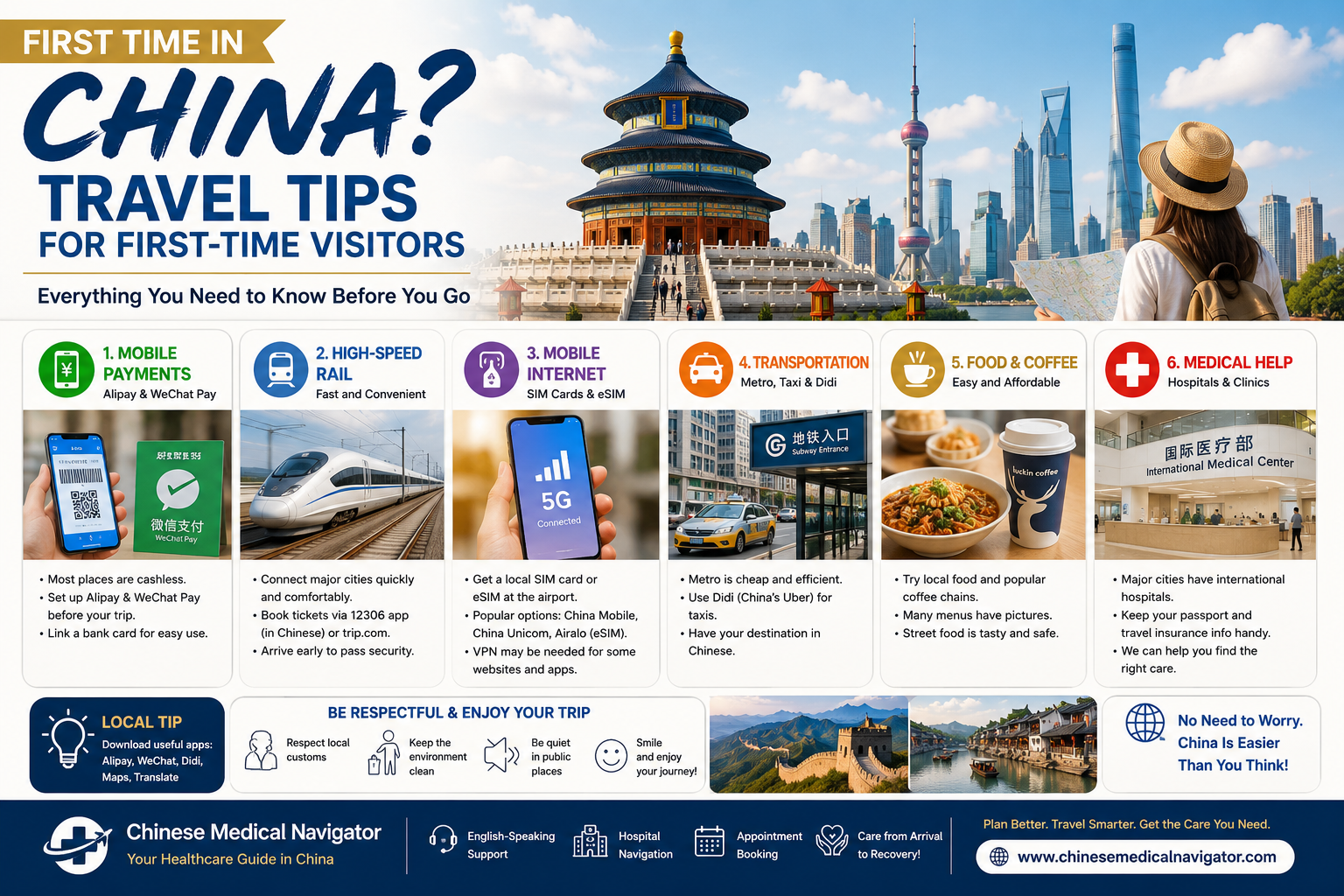
China has become one of the easiest countries in the world for daily life, transportation, mobile payments, food delivery, online shopping, and local services.
For many first-time visitors, however, the biggest challenge is not only the language. It is understanding how modern daily life works in China.
This guide is designed to help international visitors prepare before arriving in China.
Need Help in Beijing?
We help international patients with hospital appointments, translation, patient escort and practical travel support in Beijing.
Free WhatsApp Consultation Contact Us1. Download Alipay Before You Travel
Alipay is one of the most useful apps in China. Many visitors find that daily life becomes much easier after setting up Alipay before arrival.
You can often use Alipay for:
- Taxi rides
- Restaurants
- Coffee shops
- Supermarkets
- Convenience stores
- High-speed rail tickets
- Shared bicycles
- Some hospital payments
Many visitors rarely need cash after setting up mobile payment. However, it is still useful to carry a small amount of cash as backup.
2. WeChat Is More Than Messaging
In China, WeChat is not only a chat application. It is part of daily communication, business contact, payments, services, and social life.
People use WeChat for:
- Messaging
- Voice calls
- Video calls
- Mobile payments
- Restaurant reservations
- Hospital services
- Business communication
Many Chinese businesses prefer WeChat over email. If you are visiting China for medical care, travel, or business, WeChat can be very useful.
3. China Is Largely Cashless
Although cash is still accepted, many people in China rarely use it in daily life. Most payments are made through Alipay or WeChat Pay.
Foreign visitors should prepare at least one mobile payment option before arrival. This is especially important for taxis, cafes, small shops, restaurants, and daily services.
4. High-Speed Rail Is Often Better Than Flying
China has one of the world's largest high-speed rail networks. For many domestic journeys, high-speed rail can be faster and more convenient than flying.
High-speed rail may be useful for routes such as:
- Beijing to Shanghai
- Beijing to Tianjin
- Beijing to Xi'an
- Shanghai to Hangzhou
- Chengdu to Chongqing
Train stations are often closer to city centers than airports, and passengers do not usually need to arrive as early as they would for domestic flights.
5. Use Didi for Transportation
Didi is China's largest ride-hailing platform. It works similarly to Uber and can be used for city transportation.
Visitors can often access Didi through Alipay or WeChat. Prices are usually lower than in many Western countries, although they vary by city, distance, time, and traffic.
6. Mobile Internet Is Fast and Widely Available
China has extensive 4G and 5G coverage. Visitors can use Chinese SIM cards, eSIM services, or international roaming.
Having mobile internet is important because many services in China depend on apps, maps, QR codes, mobile payment, and online communication.
7. Coffee Is Easy to Find
Coffee culture has grown rapidly in China. In many cities, coffee shops are easy to find, especially in shopping centers, office districts, train stations, and busy neighborhoods.
Common coffee options include:
- Luckin Coffee
- Cotti Coffee
- Starbucks
- Local independent coffee shops
- Coffee sold on high-speed trains
A large coffee may cost around 10 to 25 RMB in many chain stores, while premium coffee shops may charge more.
8. Food Delivery Is Extremely Common
Food delivery is part of everyday life in China. The two major platforms are Meituan and Ele.me.
Visitors can order:
- Chinese food
- Western food
- Coffee
- Snacks
- Groceries
- Simple daily supplies
Delivery is often inexpensive and fast, especially in large cities.
9. Keep Receipts for Important Purchases
For hospital visits, transportation, hotels, and major purchases, it is useful to keep receipts or payment records.
Receipts may help with:
- Expense tracking
- Insurance claims
- Refund requests
- Travel documentation
- Medical visit records
10. China Is Generally Safe for Tourists
China is generally considered a safe destination for international visitors. Daily life in many Chinese cities can feel very convenient and orderly.
As with travel anywhere, visitors should keep passports secure, follow local laws, use licensed transportation services, and stay aware of their surroundings.
Useful Apps for Visitors
Before traveling, consider downloading and setting up the following apps.
Alipay
Payments, taxis, transport services, shopping, restaurants, and daily life.
Messaging, calls, business contact, payments, and local services.
Didi
Ride-hailing and taxi services in many Chinese cities.
Amap / Gaode Maps
Navigation, public transport routes, walking directions, and taxi access.
Trip.com
Hotels, train tickets, flights, and travel planning.
Meituan
Food delivery, local services, restaurant deals, and daily convenience.
For Medical Visitors
If you are visiting China for medical care, these travel preparations are especially important. Hospital visits often involve transportation, payments, mobile communication, report collection, and repeat visits.
Before your hospital visit, prepare:
- Mobile payment access
- Mobile internet
- Hospital address in Chinese
- Hotel location near the hospital if possible
- Medical records and image files
- Contact method for your local assistant or translator
Final Thoughts
For first-time visitors, modern China can feel very different from expectations. Mobile payments, high-speed rail, food delivery, and digital services are deeply integrated into everyday life.
With a little preparation before arrival, most visitors find traveling in China easier than expected.
Important Notice
This guide is for general travel preparation only. It does not replace official travel advice, immigration guidance, medical advice, or legal advice.
Chinese Medical Navigator is not a hospital and does not provide medical diagnosis, treatment recommendations, prescriptions, or medical opinions.
Need Help in Beijing?
We help international patients with hospital appointments, translation, patient escort and practical travel support in Beijing.
Free WhatsApp Consultation Contact Us- How Hospital Registration Works in China
- What Happens During a Hospital Visit in China
- Can Foreigners Get Medical Treatment in China?
Planning a Medical Visit to Beijing?
Chinese Medical Navigator helps international patients and overseas Chinese families understand hospital procedures, prepare medical documents, and arrange practical support in Beijing.
Email: contact@chinesemedicalnavigator.com
WhatsApp: +45 5380 2127